University of Alberta – Inside Out / Outside In: Laser-Etched Graphic Objects by Alicja Habisiak-Matczak
These works are hybrid graphic objects combining print matrices with sculptural form. Created using laser-etched wood and plexiglass, the inked matrices are assembled into spatial compositions, forming three-dimensional impressions of architecture.
University Wings This piece is inspired by the University of Urbino. It evokes the experience of being surrounded by architecture forming a circular enclosure. Looking upward from the center, rhythmic window patterns seem to shift and rise. The structure suggests both shelter and openness—balancing a sense of security with freedom.
Edmonton Pedways The essence of Inside Out / Outside In is reflected in Edmonton’s pedways—elevated and underground pedestrian corridors connecting office towers, commercial spaces, and public areas. Observed both from the inside and the outside, these glass-enclosed passages form a network of bridges that allow movement through the city regardless of weather conditions, especially during harsh winters. This system creates a unique spatial experience of safe, suspended urban circulation.These structures became a key source of inspiration, leading me to create works exploring the interpenetration of open urban space and enclosed architecture through elevated connectors. “Inside out” also implies knowing something “through and through.” My process involves repeated observation of a place from multiple perspectives—through extensive photography and sketching—in order to grasp its essence intuitively. To know a city “from the inside” is to access its hidden layers, often invisible to a casual visitor.
The two objects consist of two laser-etched plexiglass intaglio matrices based on my drawings. After engraving and cutting, the plates were hand-inked with Charbonnel ink and assembled perpendicularly into a three-dimensional form. Their semi-transparent structure allows light and shadow to interact, creating shifting visual distortions and enhancing the spatial illusion.
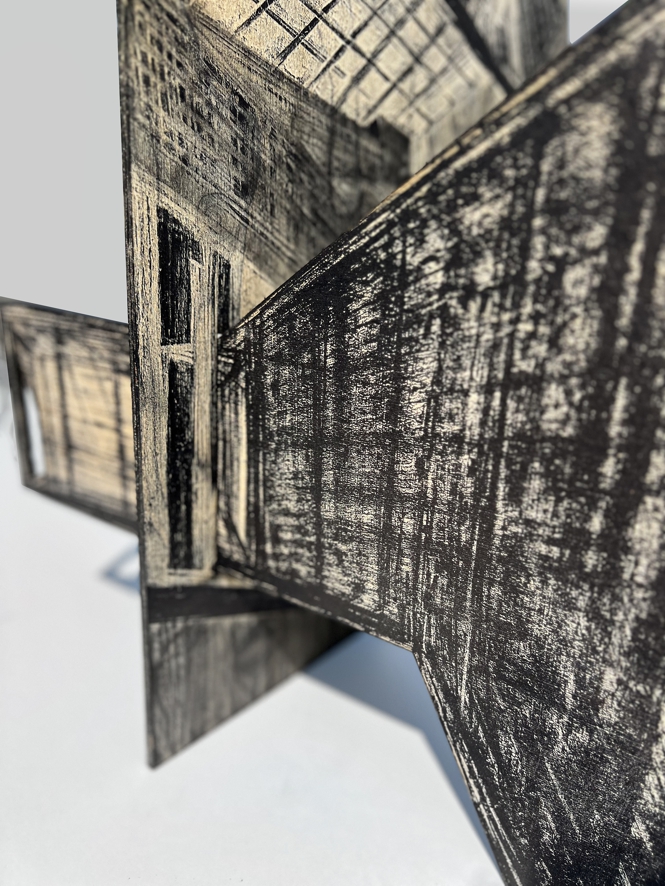
FAB Staircase Inspired by the Fine Arts Building staircase—an everyday space of circulation—the work captures the dynamic intersection of stairways and corridors. The object is composed of two laser-engraved wooden matrices, cut and printed with black ink. Engraved on both sides (positive and negative), they create varying visual effects depending on the viewpoint. Mounted perpendicularly, they form a spatial structure emphasizing movement and layered perspectives.
Process My work begins with charcoal drawings based on direct observation and photographic notes. These are digitized, processed, and translated into laser files through extensive testing of parameters such as resolution, power, speed, and filters to accurately reproduce tonal depth and texture.
MATERIAL: clear acrylic and plywood
CUT/ENGRAVED: engraved and cut
CUTTING/ENGRAVING TIME: about 40 minutes each matric, one side
FILE PREPARATION: The charcoal drawings prepared as designs for the objects were scanned in high resolution (from 600 dpi to 1200) and then elaborated in Photoshop. turned into grayscale;
For plexi curves were set to 75 % – the whole image needed to be rendered lighter as it appeared too dark on the final print unless these adjustment were made;
Levels – midtones set to 0,61 – for the same reason – to maintain a full scale of greys on the final print; the resolution was set to 250 dpi.
The file was that opened in Corel Paint. the size and resolution had to checked and adjusted if they appeared altered. After pressing “print”, next settings were applied in the Trotec Software.
For woodcut blacks and halftones were strengthened in levels settings.
To cut out an irregular shape Adobe Illustrator was used to draw an outline with pen tool with red colour. Settings for the line were: no fill, stroke 0,03 pt or hairline
RGB – R – 255, G – 0 , B – 0; it is best to have the outline saved as a separate file or layer; when reopened on the PC connected to the laser, the settings need to be double checked in Photo Paint – the settings of the line hairline, RGB with R = 255, G =, B =0.
SETTINGS USED:
FOR CLEAR ACRYLIC
V 100
P 100
1 pass
Cut once
FOR PLYWOOD
P 92,50 V 100 500
Invert ( to cut out what will be white on the print)
Halftone: stucki
Cut line: standard
Engraving: 2 passes
Cutting – cut line: 5 passes
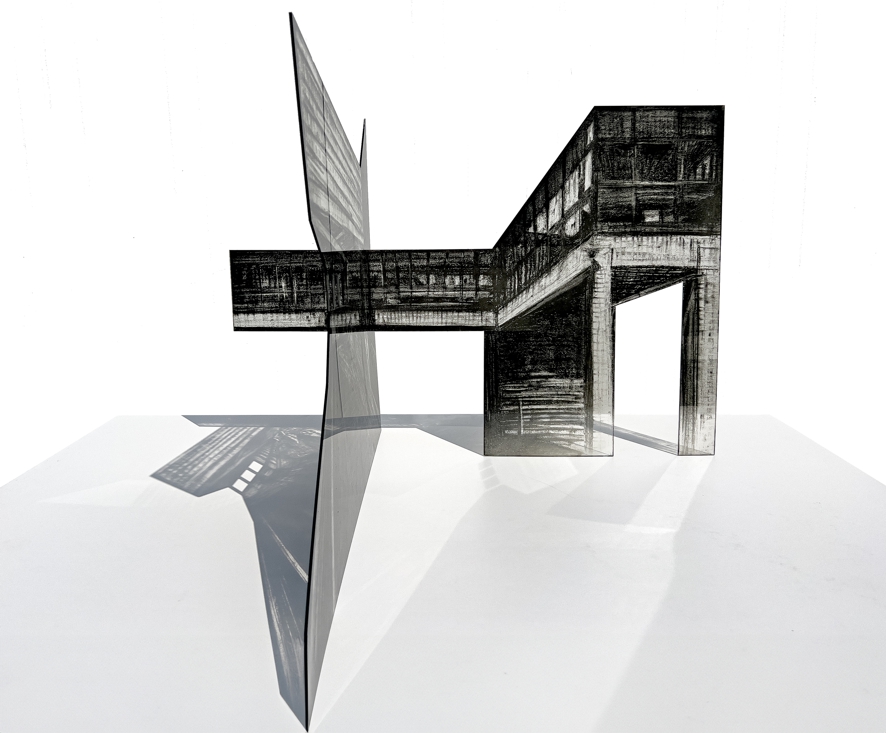
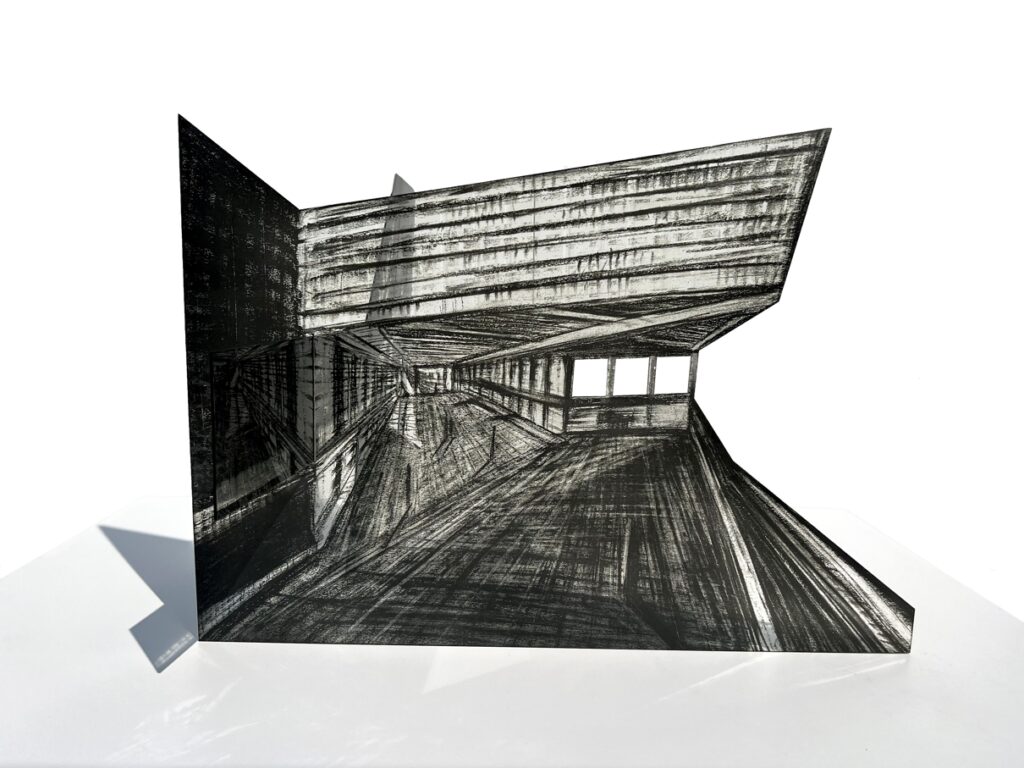
Edmonton Pedways – from Inside Out / Outside In series
two matrices of laser etching on plexi, construction connection via cutting, 60 x 85 x 85 cm,
2023
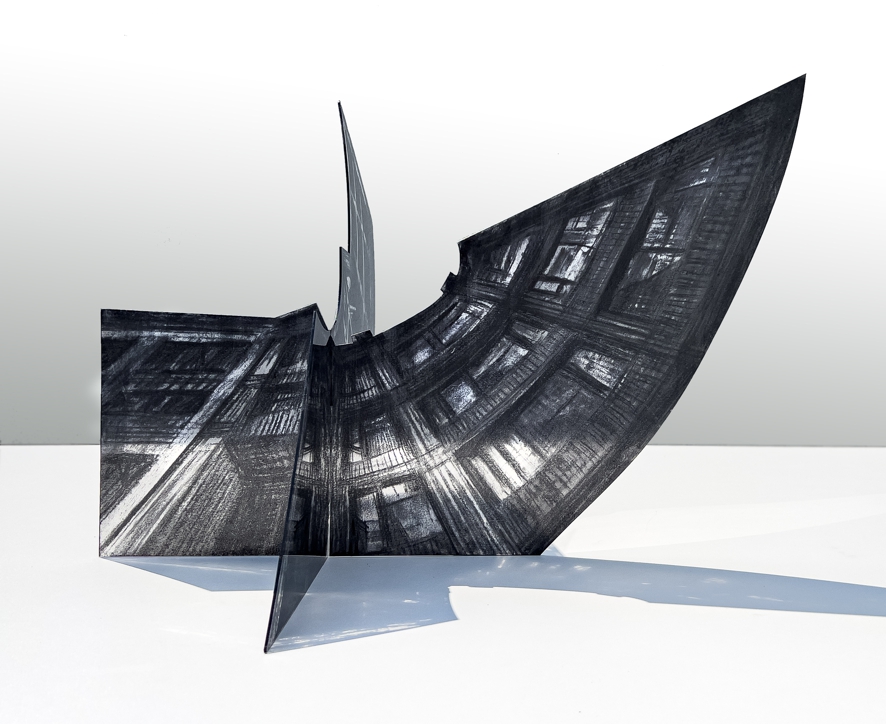
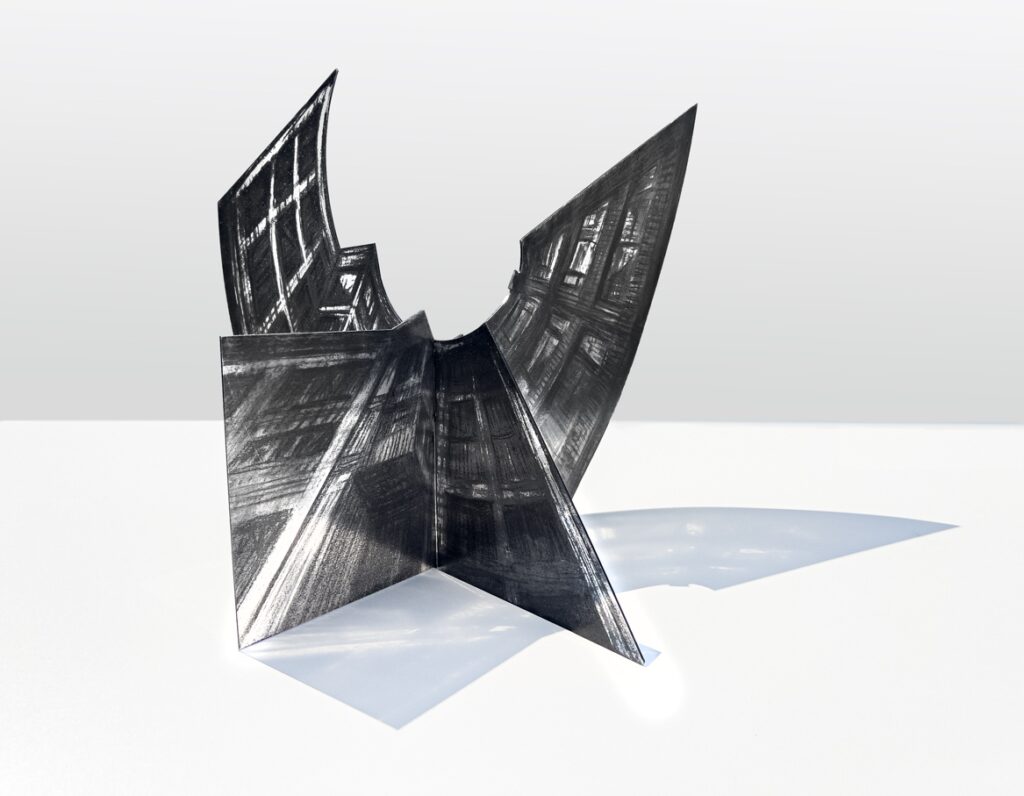
University Wings – from Inside Out / Outside In series
/ two matrices of laser etching on plexi, construction connection via cutting, 50 x 60 x 60 cm, 2023
FAB Staircase of the University of Alberta in Edmonton – from Inside Out / Outside In series
two matrices of laser woodcut, construction connection via cutting, 50 x 60 x 60 cm, 20

The ability to engrave a matrix and cut it in irregular shapes simultaneously was a breakthrough for my three-dimensional objects—a concept I have been developing since 2019 in my Drawing Sculptures series. In Edmonton, for the first time, I could translate my drawings directly into print matrices and further into unique 3D objects. The laser cutter offers exceptional precision in capturing the textures, tonal transitions, and lines of spontaneous drawing.
Clear acrylic, with its transparency combined with ink held in the engraved textures and grooves, transforms the inked matrix into a work of art in itself. This inspired me to create three-dimensional objects from such matrices. The play of light across the semi-transparent plate generates shifting reflections, producing a distinctive visual effect.
Wood can be laser-engraved on both sides, offering additional opportunities to explore dualism in printmaking—positive and negative, mirror reflections, and layered perspectives. When inked matrices are combined into an object, the warm tones of burnt plywood enhance the subtle interaction of light and shadow.